Tag: nutrition

  • Super-Energizing Baked Beans

    Super-Energizing Baked Beans

    (from The Great Cholesterol Myth Cookbook by Jonny Bowden, PhD and Steven Sinatra, MD)

    The humble baked bean is the perfect breakfast food! Navy beans—used in this recipe—are a nutritional powerhouse of plant protein, fiber, iron, magnesium, copper, and calcium that supports cellular energy and an overall healthy metabolism. The pureed tomatoes are tasty and also a good source of the antioxidant lycopene. You’ll love the savory and flavorful addition of the herbs and spices that enhance the cardioprotective benefits of this dish.

    2 cups dried navy beans
    2 tablespoons extra-virgin olive oil or ghee
    2 cups chopped onions
    1 clove garlic, minced
    2 cups tomato puree
    ½ cup organic honey
    2 tablespoons apple cider vinegar
    1/4 teaspoon ground nutmeg
    ½ teaspoon ground cinnamon
    3 bay leaves
    ½ teaspoon each: ground turmeric and cumin
    ¼ teaspoon each: black pepper and salt (Celtic or sea)

    Soak the beans overnight. Drain and rinse under cold water. Add the beans to a large pot, cover with water, and bring to a boil. Reduce the heat to a simmer and cook for up to 2 hours.

    Preheat the oven to 300 degrees

    Drain the beans and place them in a large casserole dish, in a small skillet, heat the oil or ghee and sauté the onions and garlic until browned, about 3 or 4 minutes. Add the onions and garlic to the beans and combine. With the lid on, bake the beans for 3 hours, stirring frequently. Check the moisture level and water if needed. After 3 ½ hours, remove the cover and bake for another 30 minutes.

    Yield: 1 quart – approximately 8 servings

    Note: the insoluble fiber in baked beans is not fully digested but moves into the large intestine or colon, where friendly bacteria thrive on it to produce beneficial B-complex vitamins, enzymes, and short-chain fatty acids.

  • Veggie Slaw with Flax Oil

    Veggie Slaw with Flax Oil

    Prep time: 20 minutes if hand cutting, 10 minutes with food processor

    Cook time: none but flavors improve with resting time a couple of hours


    Ingredients:

    2 1/2 tablespoons of flaxseed oil* (I recommend Barlean’s brand)
    2 1/2 tablespoons of raw apple cider vinegar
    2 1/2 tablespoons fresh lemon juice
    1/4 teaspoon sodium free lemon pepper
    Half small to medium head red or green cabbage cord, quartered, and finely sliced
    Three stalks broccoli, crowns removed, peeled, and thinly sliced
    4 carrots grated or thinly sliced
    4 stalks celery, finely sliced

    * you can also use extra-virgin olive oil

    In a large bowl combine oil vinegar lemon juice and lemon pepper and whisk together to combine. Add the cabbage broccoli carrots and celery. Toss to coat with dressing. Refrigerate for several hours. This will keep up for a week if you keep it cold and tightly sealed

    Yield 8 to 9 cups


  • Baby Spinach Salad with Fresh Raspberries

    Baby Spinach Salad with Fresh Raspberries

    Prep time: 5-10 min

    Cook time: none


    Ingredients:

    6 cups baby spinach
    ½ cup crumbled feta or goat cheese
    1/3 cup sliced almonds, walnuts or pecans
    1 cup fresh raspberries
    2 Tbsp. raspberry vinegar
    2 Tbsp. raspberry jam
    ½ tsp. Dijon mustard
    ½ tsp. raw honey


    In large salad bowl, combine the spinach, cheese, nuts, and raspberries.

    In a small bowl, whisk the vinegar, jam, mustard, and honey. Drizzle dressing over the top of salad and toss gently to coat. Serve immediately

  • Jonny’s Mega Omega Salmon in a Snap

    Jonny’s Mega Omega Salmon in a Snap

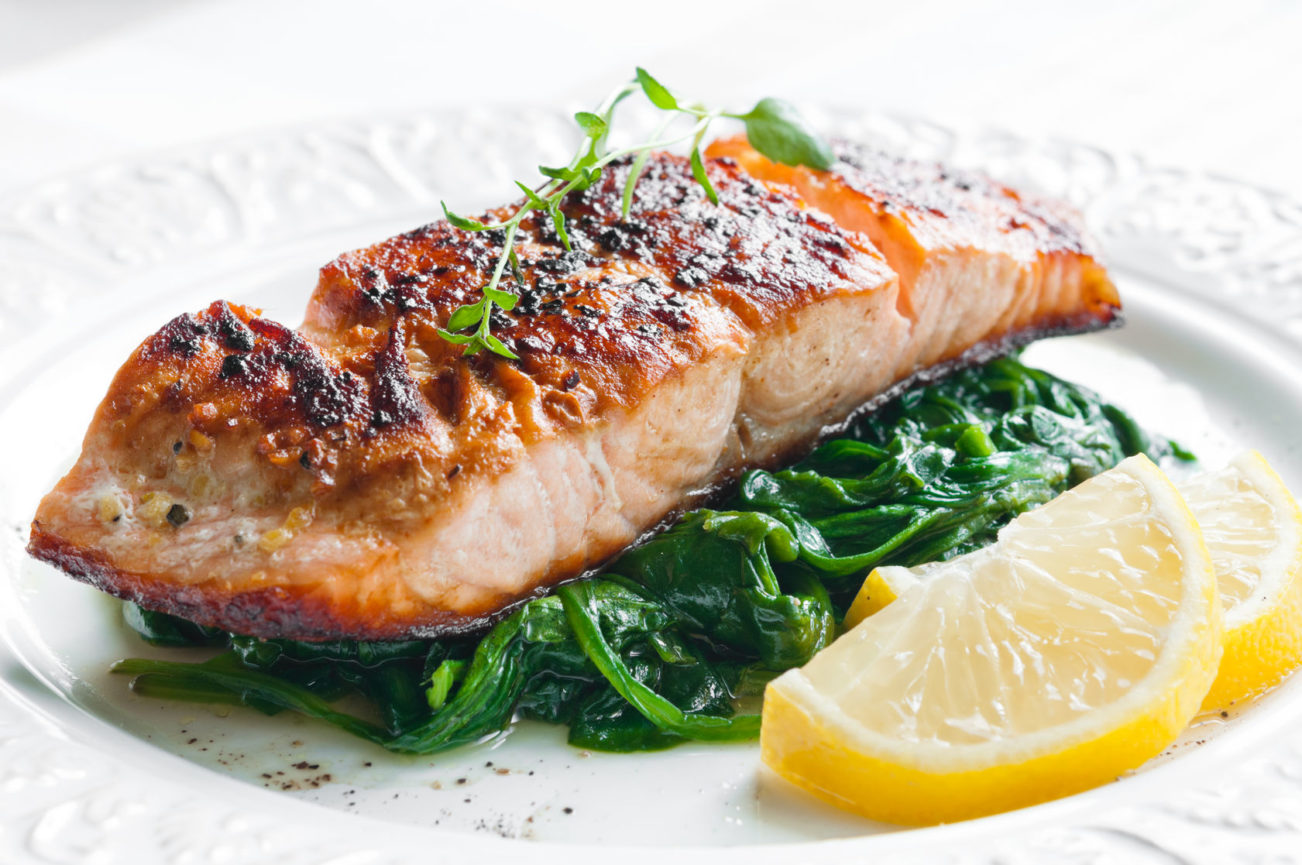
    Wild salmon blends beautifully with sauteed spinach, and when both are lightly cooked in the best coconut oil on the planet, the resulting taste is superb. I love the organic spice pack that comes with the salmon I get from Vital Choice, but you can make your own spice mix or use salt and pepper– just don’t forget the turmeric. Turmeric is the superspice of all time, having both serious anti-inflammatory properties and some anticancer activity as well.

    Ingredients:

    1 ½ tablespoons (25ml) Barlean’s coconut oil
    4 Vita Choice Wild Alaskan Skinless Salmon fillets (6 ounces or 170 g each), thawed
    2 Vita Choice organic spice packs (included with salmon order, or use salt and pepper to taste)
    1 bag (6 ounces or 170 g) triple-washed baby spinach
    1 teaspoon on turmeric
    ¾ teaspoon lemon pepper
    2 tablespoons (28 ml) water
    2 teaspoons butter

    Instructions:

    Heat the coconut oil in a large Dutch oven over medium-high heat. Add the salmon fillets to the pan and sprinkle Vita Choice spice packs to taste over the surface or fillets. Sear for 1 minute or until lightly browned. Flip and sear the uncooked side for 1 minute, sprinkling the spice packs on the seared sides, to taste. Reduce the heat to medium low and add the spinach.

    Sprinkle the turmeric and lemon pepper over the spinach and add the water. Cover for 2 minutes. Remove the cover, add the butter, stir, and recover for about 1 to 3 minutes or until the salmon is cooked to your liking, Do Not Overcook!

  • The Death of the American Breakfast Cereal?

    The Death of the American Breakfast Cereal?

    The cereal business is in the toilet.

    According to a report in the business section of the New York Times, sales of flaked cereals (like the iconic Corn Flakes) are down 5.5% and sales of all types of cereals are down 10.7%. The title of the print version of the article– Mikey Doesn’t Like It Very Much, Anymore– refers to the iconic 1974 television commercial in which two brothers are trying to get their very picky little brother to try a new “healthy” cereal called Life that neither of the brothers has any interest in eating.

    “Let’s get Mikey to try it”, one of them says. “He won’t like it. He hates everything.”

    Apparently, we are all Mikey now.

    To which I say, “Hallelujah, brother!”

    As someone who’s not exactly known for mincing words, let me be blunt: Cereal is crap. The overwhelming majority of it is processed dreck, nothing more than candy with a good PR campaign. The memes about cereal are implanted early in our lives—just think of your associations to Wheaties and Cherrios, two utterly useless food products each of which has over 20 grams of processed carbohydrates per serving. Wheaties in particular has benefited from one of the best public relations campaigns since “Betcha can’t eat just one”, which is why the first thing most of us think of when we hear “Wheaties” is “Breakfast of Champions”.

    If you think that crap is really the “breakfast of champions”, then I’ve got some really lovely property to sell you right under the Brooklyn Bridge.

    The god-awful, sclerotic American Dietetic Association—oh, excuse me, they’ve now renamed themselves the “American Academy of Nutrition and Dietetics”, since they apparently think that a new name will make them seem more relevant —has been shoveling the party line about cereal being a great source of fiber for as long as I can remember, but that’s a load of unmitigated do-do. The average cereal has about 2-3 grams of fiber per serving. Compare that to the 11-17 grams per serving of beans or 8- 10 grams per avocado. Cereal as a “fiber heavyweight” is as much a myth as the Loch Ness monster.

    And while many commercial cereals claim to only have a few grams of sugar, that’s more a function of creative labeling, fuzzy math, and hidden agendas– the same kind of thinking that winds up classifying ketchup as a vegetable. Manufacturers can be very creative when it comes to deciding which carbohydrates they consider “sugar”. And it doesn’t much matter anyway, because these processed carbs turn into sugar in the body faster than you can say “diabetes”. Fiber heavyweight? Sorry, Charlie.

    I’m almost angrier about the poseurs like Life, Grape Nuts, Special K and Total, because they actually pretend to be health foods and lure unsuspecting, overworked moms into thinking that they’re doing their families a favor by feeding them this stuff. No one pretends that Lucky Charms and Captain Crunch are anything but candy, but many people believe that the “healthy” cereals like Life– which has 25 grams of carbohydrate, 6 grams of sugar, and a paltry 2 grams of fiber –are actually healthy.

    Umm…..not so much.

    Look, the field of nutrition is experiencing the beginning of what Thomas Kuhn, in The Structure of Scientific Revolutions called “a paradigm shift”. New research continues to pile up making it harder and harder to ignore the fact that we were bone-headedly wrong about saturated fat and cholesterol. Not coincidentally, it’s also becoming increasingly apparent that we were dead wrong about the demons in the American diet.

    It was never dietary fat that was the enemy. It was never fat that was making us sick, fat, tired and depressed.

    It was sugar. And foods that the body converts to sugar in a New York minute.

    Like the overwhelming majority of commercial breakfast cereals.

    So I’m not exactly shedding tears for General Foods and General Mills. They’ve been selling us this crap for decades, spending millions of marketing dollars to convince us that these cash cow food “products” are actually necessary for our health, while plying organizations like the American Dietetic Association with millions of sponsorship dollars to keep sending out the message that we should build our diet around healthy “complex” carbs.

    And please, don’t buy into the marketing drivel about “whole grains”. You can’t pluck a grain from the earth and eat it—all grains require processing, and by the time a grain (whole or not) has been pounded and pulverized into flour, or turned into a flake of “Special K”, you might as well be eating pure sugar. Why do you think they have to “fortify” cereals in the first place? They’re just putting back tiny amounts of the vitamins and minerals that were lost in the processing. You might as well take a multi-vitamin and save the calories.

    When it comes to commercial breakfast cereal, I feel like the kid who’s been shouting “the emperor has no clothes—(and by the way, his body’s not that great either)” for about a decade.

    Except now the grown-ups are finally paying attention.

  • Does it Really Cost More to Eat Healthy?

    Does it Really Cost More to Eat Healthy?

    I want to talk to you about two subjects virtually everyone is interested in: food and money.

    Specifically, I want to address the frequently heard complaint that it costs much more to eat healthy.

    Don’t worry—I’m not going to give you a lecture about how much broccoli you could eat for the price of a Big Mac, or how, if you were really inventive, you could make a four course nutrient dense meal for the price of two large bags of Dorito’s and a 2 liter coke.

    That stuff may be true, but it doesn’t speak to your experience, which is that calories are generally cheap, and good food (like grass-fed meat) isn’t. And that it takes a lot of work (and time!) to make healthy food that’s economically viable, while dropping by the take-out window at Taco Bell takes neither.

    So let me start by saying two words about that: It’s true.

    And let me follow it with two more: So what?

    Now before you think I’m being calloused and unsympathetic, hear me out. When President Herbert Hoover spoke inspiringly of putting “a chicken in every pot”, chicken was an expensive commodity—in 1930, you’d pay a whopping $6.48 a pound for chicken (in today’s currency). Last year, in contrast, the price was $1.57.

    So this is a good thing, right?

    Well, yes and no.

    See, one of the casualties of modern life is we’ve lost the ability to think ahead. We’re so focused on the now, on immediate ratification, that few of us stop to think of long range costs. This is why we have a credit card crisis in America. This is why “buy now pay later” is virtually the national anthem. And it affects every area of our lives. People lease cars based on how much their monthly payment is, not how much the real cost of the lease is over 3 years. We pay the minimum requirements on our credit card. We eat what tastes delicious now and figure we’ll start our diet “tomorrow”. Everything in modern life is skewed to sacrifice long range consequences on the altar of immediate reward. If it feels good now, do it—and worry about the consequences later.

    And you can see just how well that’s been working out.

    So sure, we can now get chicken for a buck and a half a pound. But the real costs of that “bargain” are hidden. Chickens are bred to grow breasts so large that they literally topple over and can barely breathe or stand. They are shot full of hormones, steroids and antibiotics (a contributing factor in the looming crisis around antibiotic-resistant bacteria). Many health professionals feel the “meat-cancer” connection that seems to show up in some association studies has little to do with meat and everything to do with the chemicals and hormones that the meat is filled with.

    Sure, you can buy that kind of meat a lot cheaper than you can buy pasture-raised. But you’re kicking the can down the road. You may not be paying more cash at the register right now—but payment will come due just as sure as death and taxes, and it won’t be cheap.

    That many diseases and conditions are lifestyle related is no longer in doubt. Lifestyle choices—and dietary choices especially—have a huge influence on cancer, cognitive impairment, diabetes, obesity, and heart disease. Calories are cheap in the standard American Diet, but the costs of that diet are anything but. You just don’t have to pay for them right now.

    But pay for them you will. Make absolutely no mistake about that.

    So does it cost more money to eat healthy? Sure it does—at least at first. But it costs even more not to eat well. You might not notice it right now, today, at the cash register. But a decade or two from now, the bill will come due.

    And it won’t be fun.

    Look, one of the most difficult lessons any of us as parents have to teach our children is to look at the long range picture. A 20 year old doesn’t care about what happens when he’s forty (let alone sixty)—he cares about Friday night. (That’s why it’s so hard to get kids to save money.)

    But are we adults really any different?

    Look, I have an advantage over a lot of you in that I’m in my 60’s and I know how this game turns out. I’m passionate about making people understand how much it matters to eat well when they’re younger because I know what it feels like “on the other side”. I’m 67, look 47, feel 37, and act 27. I have boundless energy. I get up without an alarm clock at 6 AM. I play tennis every day. I have a healthy libido and a wonderful relationship. I have a great career, amazing health, an optimistic outlook and I look forward to every day.

    And I know—I know—that’s because I’ve been eating well (albeit a bit more “expensively”) since I was 38. And, like a person who’s been putting a few bucks away every month since he’s twenty and now, at 70, is enjoying millionaire status, I’m enjoying the results of 30 years of spending a little more and eating a little better.

    And I can tell you that it’s worth it. Big time.

    So does meat from grass-fed cows, eggs from free-range chicken, organic coffee and milk and strawberries and all the rest of it cost more? Sure it does. In the short run.

    But if you can lift your head over the horizon to see the long view, that extra cash you’re laying out now will pay off in benefits you can’t even imagine.

    Do the math. And then tell me whether or not it’s worth it.

    I think it’s a no-contest. How about you?

  • You’re Probably Not Getting Enough of This Critical Nutrient…

    You’re Probably Not Getting Enough of This Critical Nutrient…

    I’m often asked by magazines to compile lists of the most important supplements to take on a regular basis. One supplement that always makes the cut—no matter what—is magnesium, and here’s why.

    First of all, magnesium deficiency can affect virtually every single organ system in the body. It’s involved in more than 300 enzyme reactions in the body, including fat, protein, and glucose metabolism, muscle and membrane transport, and energy production.

    In a classic article called The Importance of Magnesium to Human Nutrition, Michael Schachter, M.D, devotes a full four paragraphs to the possible symptoms and problems associated with getting too little magnesium—they range from salt and carbohydrate cravings to panic attacks, PMS, mitral valve prolapse, palpitations, cramps, muscle tensions, and insomnia.

    When I was a personal trainer and clients came to me with muscle cramps, the first order of business was always to make sure they were getting enough magnesium and potassium through supplements and food. That almost always takes care of the problem.

    Second of all, it’s a relaxer—magnesium actually helps open up the blood vessel walls, making it very important for keeping blood pressure in a healthy range. (In fact, magnesium is one of the key recommended supplements in the nutritional protocol at the highly regarded Hypertension Institute in Nashville. You can read about it in my friend Mark Houston, MD, MA’s excellent book, “What Your Doctor May Not Tell You About Hypertension.”)

    Third of all, it’s terrific for helping to lower or at least stabilize blood sugar, making it a top supplement in virtually all of the intelligent diabetes protocols I’ve ever seen. Magnesium also plays a critical role in the secretion and action of insulin. In the Nurses’ Health Study and the Health Professionals Follow-Up Study, the risk for developing type 2 diabetes was significantly greater in both men and women with a lower intake of magnesium.

    Speaking of which, almost no one is getting enough. Surveys consistently show that almost 3/4 of all Americans don’t even get even the paltry amount recommended in the Dietary Reference Intakes (DRIs) developed by the Food and Nutrition Board (FNB) at the Institute of Medicine of the National Academies (formerly National Academy of Sciences). (Those numbers range from 310 mg a day to 420 mg a day depending on sex, age and pregnancy, and most nutritionists I know, including me, consider them laughingly and inappropriately low.) According to a study in the Journal of the American College of Nutrition, 68% of American consumed less than the recommended daily allowance of this critical mineral. Even the National Institutes of Health states that “dietary intake may not be high enough to promote an optimal magnesium status, which may be protective against disorders such as cardiovascular disease and immune dysfunction”.

    So magnesium supplements always make my list of “most important to take on a daily basis”.

    Which brings me to Effervescent Magnesium Citrate by DaVinci Labs.

    While I take many of my supplements in pill form, I’m also a big fan of mixing them into shakes and drinks when an appropriate form can be found. I’ve tried mixing regular magnesium powder into shakes and, frankly, it usually doesn’t taste very good. What I love about effervescent magnesium citrate is it actually tastes like an orange drink. You can drink it by itself, mixed in water, or with a whole concoction of other powders, like I do. In fact, the orange, stevia-sweetened powder adds a nice fizzy texture and flavor to even icky tasting powders like the kind I drink regularly!

    Now, instead of holding my nose when I drink down my daily morning powdered supplement mix, I actually look forward to it.

    One small scoop provides 420 mg of magnesium citrate, and—just for good measure—a very nice 390 mg of potassium to boot.

    This is a great product that I use every single day. Highly recommended! Try it now »

  • Does a pH Balancing Diet Work?

    Does a pH Balancing Diet Work?

    Guest article by Monica Reinagel, MS, LD/N aka “The Nutrition Diva” ™

    Many people are convinced that balancing the pH of your diet will help keep you healthier. There are several popular diet books based on this idea and you can find lists of acid- and alkaline-forming foods on the Internet. Lots of you have written to ask whether this is something you need to pay attention to.

    The Acid/Alkaline Theory of Health

    The acid/alkaline theory of health and disease goes something like this: Every food you eat leaves a residue in the body after it is fully digested. That residue, or ash, is either acidic or alkaline. This has nothing to do with whether the food itself is acidic. Lemons, for example, are acidic, as you can tell by their pucker-factor. And yet lemons leave an alkaline residue.

    To keep this from getting confusing, the preferred terminology is that a lemon is an acidic food, but not an acid-forming food. Some people believe that if we eat too many acid-forming foods our blood and/or tissues become acidic and that this promotes disease. They reason that eating more alkaline-forming foods will balance the pH in our bodies and restore health.

    What are the Acid- and Alkaline-Forming Foods?

    In general, fruits and vegetables are alkaline-forming, and meats and grains are acid-forming. But it gets way more complicated than that. You can find lists of acid- and alkaline-forming foods on the Internet–but I’m not entirely sure where these lists come from or how they are generated. I’ve never seen one that had any citation or source information attached to it. Furthermore, they tend to contradict one another–foods are listed as acid-forming on one website and alkaline-forming on another.

    That’s one of things that makes me wonder about the validity of this theory. The other thing that I find notable is that in all the medical literature, I cannot find one study that’s ever tested this theory.

    Researchers love to test theories. That’s what they do! And just about every diet theory that’s been proposed in the last thirty years has been the subject of some sort of published research. You can find studies on the effects of anti-inflammatory diets, low-carb diets, low-glycemic diets, high-protein diets, vegan diets, and Mediterranean diets. But apparently, no serious researchers have ever found the acid/alkaline theory plausible enough to look into.

    Why not? After all, it’s absolutely true that maintaining the proper pH in your body is crucial–not just to staying healthy, but to staying alive at all. If your blood got even slightly too acidic or too alkaline and stayed that way for more than a few minutes, you’d be in a coma or worse. But what you eat actually has very little effect on the pH of your blood. Believe me, nature is not about to let your survival hinge on dietary discretion.We have several systems in place to maintain pH balance in our bodies, no matter what we eat.

    Flushing the Evidence

    If you’ve read anything about this theory, you might have come across the part where they tell you to test the pH of your urine. You can buy inexpensive pH sticks at the drug store and pee on them. If you try this, you’ll see that what you eat does change the pH of your urine. And to some, that is proof that the acid/alkaline theory is true. But actually, the reason that the pH of your urine is changing is so that the pH of your blood doesn’t. The kidneys are one of the major ways that your body maintains a constant pH.

    Worrying about the pH of your urine makes about as much sense as worrying about the dirt in your trash. Both are leaving the premises. The trash is carried out to the curb and any dirt it contains isn’t going to make your house dirtier. Likewise, the urine is being flushed and isn’t making your body any more acidic.

    Are There Consequences to Eating Too Many Acid-Forming Foods?

    There’s a slightly more sophisticated version of this theory that acknowledges that a healthy body is able to maintain its pH no matter what you eat. However, if you eat too many acid-forming foods, the effort of maintaining pH will deplete the body’s energy or resources, leaving you vulnerable to disease. For example, another way that your body balances pH is to pull calcium from the bones. So, it follows that eating too many acid-forming foods might promote bone loss.

    Again, I’ll just point out that the long-term consequences of a so-called acidic diet are purely theoretical. They have never been confirmed by any sort of direct research that links the acid/alkaline residue of the diet with health outcomes. But we certainly have plenty of indirect research. For example, the effects of high-protein diets, which are presumably high in acid-forming foods, have been studied.

    In fact, you might recall a recent episode that I did on nutrition and bone health. I mentioned that high-protein diets can increase bone loss—but only in people who are calcium deficient. In other words, if you are getting enough calcium and other minerals in your diet, you’ll have more than enough to maintain your bone mass and buffer the effects of acid-forming foods.

    Why You Might Want to Follow a pH Balanced Diet ANYWAY

    For now, the acid/alkaline theory of disease is just that: a theory. Parts of the theory are plausible; some are a little silly. Most are untested. And, maybe one day, researchers will do some large-scale studies on the effects of dietary pH on health. When they do, I have a feeling they might discover that people who eat more alkaline foods are, in fact, healthier.

    After all, what would that diet look like? It would be high in fruits and vegetables. And, unless this is the very first episode you’ve ever listened to, you can probably recite with me the many benefits of eating more fruits and vegetables.

    A diet high in fruits and vegetables is going to be high in antioxidants, vitamins, minerals, and fiber. Plus, if you’re also trying to limit your intake of acid-producing foods– which are meats and grains–you’re probably going to end up cutting out a lot of foods that are also high in sugar, fat, calories, and sodium. Regardless of the pH aspect, that sounds to me like a good way to improve your health.

    In other words, I don’t think anybody is going to get hurt following a pH-balanced diet, as long as the diet is otherwise balanced and nutritious. I just think that it’s an unnecessarily complicated way to get to the same old punch-line: Eat more vegetables, less junk, and nothing to excess.


    About the Author: Monica Reinagel is a licensed nutritionist and author of Secrets for a Healthy Diet: What to Eat, What to Avoid, and What to Stop Worrying About. For more of Monica’s evidence-based nutrition advice, check out her weekly Nutrition Diva podcast. View the complete archive »

  • Infographic: Heart-Healthy Moving Advice

    Infographic: Heart-Healthy Moving Advice

    Heart-Healthy Moving

    Infographic design and illustration by Kena Ravel for MyMove

  • My New Morning Ritual

    My New Morning Ritual

    From time to time, I stumble upon a product I didn’t expect to like but actually do—which is exactly what happened with Garden of Life’s Raw Meal.

    It’s no secret that I’ve never been a huge fan of Garden of Life, but I’ll be the first to admit that the reason for that has little to do with their product.

    No, my prejudice came from the fact that the founder of Garden of Life and I were in a class together many years ago and, frankly, I just didn’t much like the guy. So there, I admit it, my prejudice about the company was very colored by an insignificant incident 15 years ago, but then again, who ever said prejudices were smart?

    So I’m browsing through the catalogues of the various companies, and I see this product by Garden of Life—Raw Meal—and the description sounds so fascinating that I decide to order it.

    Which I did.

    Well, let me just be honest and say this: It’s great.

    I mean, seriously great. Like it’s my go-to meal replacement these days. And let me tell you why:

    • First of all, it tastes great. (I’ll tell you how I personally prepare it at the end of this newsletter.)
    • Second of all, it has 17 grams of protein in a half serving, 34 grams in a complete serving. (More about this “serving” business in a minute.)
    • Third of all, a full serving has a remarkable 10 grams of fiber, and even a half serving has 5 grams, more than 95% of the crummy cereals we’re told to eat for their “high fiber” content.. (but don’t get me started).

    Full Serving vs. Half Serving

    Here’s the deal with the “full serving” and “half serving”. You can use this powder as a meal replacement (full serving) in which case you use two scoops and it provides 310 calories; or you can use it as a mini-meal or snack, in which case you use one scoop and it provides 155 calories. If you use it as a meal replacement, you can throw in all kinds of goodies like berries, raw oats, raw milk,  almond milk, Forti-Flax, even a handful of nuts if you like, essentially designing your own meal with as many (or as few) calories as you like.

    You can even add a scoop of protein powder, like Designs for Health Whey Cool, to up the protein content a bit. And you can do the same for the fiber by adding in a small scoop of Paleo-Fiber. It’s like adding options to the base model of a car. You can add them on—but you don’t have to!

    Raw Meal provides twenty essential vitamins and minerals, in many cases 100% of the RDA (pitiful as that number is). In addition, there’s a RAW probiotic and enzyme blend, with about 3 billion CFU of lactobaccilus acidophilus and digestive enzymes. The protein is completely derived from plant sources.

    It’s “Green” Too!

    I was also pleased to find that this company really cares about the planet, and seems to have a true commitment to sustainability. They use only certified organic plant protein from sprouted grains and legumes, and they use only recyclable packaging, vegetable inks, sustainably farmed papers and 100% certified renewable wind energy credits to run their operations. Gotta give ‘em props for that.

    How I Enjoy Raw Meal

    All this probably wouldn’t matter so much if the product didn’t taste great, but it does. Seriously, folks.

    Here’s the way I personally like it. Try this and tell me if it’s not the greatest thing ever. (A warning note, though. I make things in the kitchen entirely by feel, so please forgive me if this doesn’t exactly follow recipe protocol. Experiment with it and I promise you’ll find a mix you love!)

    1. Take a glass of raw, whole milk and put it in a blender. (Raw milk is still legal in a couple of states. If you can’t get raw, whole milk, use almond milk. I usually use about 7/8 raw whole milk and then top it off with a dollop of almond milk anyway, just for flavor.)
    2. Throw in one scoop of Raw Meal
    3. Add a small handful of berries
    4. Add a tablespoon or so of Forti-Flax
    5. Throw in a small handful of almonds (I like dry roasted in Bragg’s Aminos, but any good almonds will do.)
    6. Throw in a small handful of coconut flakes (we get these prepackaged at the supermarket—in either little containers or in plastic bags.)
    7. A tiny spoonful (probably a ½ teaspoon to teaspoon) of Manuka Honey
    8. A scoop of fiber – I like PaleoFiber
    9. Blend and drink!

    If it comes out too thick—or looks like it will—add more almond milk, or even some ice cubes to thin it out a bit. But don’t thin it out too much. When it’s just right it’s creamily delicious, with a nutty, crunchy texture.

    And let me know if you don’t love Raw Meal as much as I do!

    Supplements Mentioned in This Article

    Raw Meal by Garden of Life


    Forti-Flax by Barlean’s Greens


    PaleoFiber by Designs for Health


    Whey Cool by Designs for Health