Category: Recipes

  • It’s Heart Health Month—Don’t fall for the BS

    It’s Heart Health Month—Don’t fall for the BS

    It’s heart health month, the time of year when I typically get apoplectic reading all the bullshit about how important it is for us to check our cholesterol.

    And with a new class of cholesterol lowering drugs about to hit the market, you can count on aggressive campaigns to get you to pay attention to your cholesterol levels, and how great these new drugs are when you combine them with a statin, which is what they did in the research. So now, you can be on two drugs to solve the terrible problem of high cholesterol (although I saw an encouraging article recently that said that the new drugs—Repatha and Praluent—aren’t selling. Such a pity.)

    Two drugs that may lower cholesterol stupendously. But which do very little if anything for lowering the risk of heart disease.

    That’s because—- as I said on the Dr. Oz show—trying to lower the risk of heart disease by lowering cholesterol is like trying to reduce your risk of obesity by giving up lettuce.

    So let’s start with one, basic, incontrovertible, evidence-based, non-alternative fact: Cholesterol does NOT cause heart disease. Not even close. It’s actually not even a good predictor of heart disease. Fully half the people admitted to US hospitals with cardiovascular disease have perfectly normal cholesterol. Tim Russert, the beloved host of Meet The Press, dropped dead on a treadmill at the NBC studios with his cholesterol perfectly in check.

    Now that we’ve got the cholesterol thing out of the way, let’s talk about what does cause heart disease, and, more importantly, what we can do about it. Which turns out to be a lot (more on that in a moment).

    Heart disease doesn’t have a single cause. Many different factors can contribute to a weakened heart, just as they can to a weakened immune system. And when the heart—or more precisely, the cardiovascular system—is weakened, it doesn’t take as much to overwhelm it.

    Imagine building a fence out of bamboo around a house on the coast of Florida. That fence may stand perfectly straight in good weather, but at the first sign of a hurricane, goodbye fence. (A fence made of something more substantial would be exposed to the same hurricane winds, but probably wouldn’t get knocked down.)

    Your body is like that fence. When your system is weakened by a diet high in sugar and starch, by stress, by inflammation, by oxidative damage, by the absence of exercise and the presence of toxins, it’s like having a fence made of paper maché. In our book, The Great Cholesterol Myth, my co-author, cardiologist Stephen Sinatra, MD, tells the story of a banker who was felled by a heart attack after hearing a bit of minor bad news. His system was so weakened that even a minor setback was enough to bring him down.

    Think about all the stories you’ve heard about couples who were married for 57 years, one dies, and the other is gone within a month. (Case in point: my grandparents.) The grieving survivor’s system is simply overwhelmed, flooded with cortisol (which depresses immunity), their will is gone, their physical resources depleted and they simply die, often triggered by an ordinarily innocuous bacteria or virus. Thinking we are speaking metaphorically, we might say of that person that he died of a broken heart—- but a broken heart might be closer to the truth than we think.

    We weaken our systems every time we consume sugar, soda, donuts, French fries, or any of the other staples of our great American experiment in horrible diets. Our system is further weakened by exposure to the toxins in the air we breathe, the water we drink, the food we eat and the stress we experience. All add up to a significant increase in our susceptibility to heart disease. Cholesterol has absolutely nothing to do with it.

    And one more thing—perhaps the most important. Have you ever noticed that there are no newspaper articles—let alone studies—of healthy, robust centenarians that live in isolated cabins in the wilds of Montana? That’s because there are no such people. All the places in the world where they have the highest concentration of healthy 100-year olds have one thing in common, and it’s not their diet, their exercise, their supplementation program or their genetics.

    It’s the fact that they all have strong social connections.

    And I’m not talking Facebook friends, I’m talking real people whose eyes you can actually look into when you talk to them. Who you talk to with actual words, not texts. The social fabric is such a strong protector of health that it may even counter the negative effects of some really bad risk factors.

    There’s even a name for this phenomenon—The Roseto Effect— named after a close-knit Pennsylvania community with a heart attack mortality rate about half that of all the surrounding areas, baffling all the scientists and researchers of the day .

    The people of Roseto lived a really hard-scrapple life. They worked in toxic slate quarries, inhaling horrible gases, dusts and other awful stuff. They smoked. Their diet was as bad as you can imagine. But the town was mostly composed of closely-knit Italian immigrant families who had an incredibly strong social fabric. They shopped locally, patronizing their neighbors’ businesses. They didn’t show off, or care terribly about status. They attended the same churches, went to the same schools. They didn’t seem terribly unhappy or stressed out. They ate family dinners together, and had virtually no crime in their neighborhoods. They had a sense of purpose and a sense of connection to things outside (and bigger) than themselves. And they took care of one another—though hardly a well-heeled town, they had a very low percentage of people on public assistance.

    Apparently that lifestyle protected them a hell of a lot more than a statin drug.

    Look, let’s face it. You can’t completely eliminate the risk of heart disease. But you can do an awful lot of things to reduce the risk of it killing you. You can eat real food—food your grandmother would have recognized as food. You can move. A lot. You can get up and walk around for a few minutes every hour or so, so you never sit for extended periods of time. You can get some sun, and take a walk in the woods. Play with a pet. Make love. Meditate. Spend a few minutes every day contemplating the things you’re grateful for. Eat an apple. Drink some tea. Dance like no one’s looking. Take fish oil, vitamin D, magnesium, and probiotics. Laugh. Make someone else feel good—every single day of your life.

    These are the things that create a strong “fence” They ultimately protect you and insure that you’re as strong, healthy and fit as you can possibly be.

    That’s how you protect your heart.

    Lowering your cholesterol has absolutely nothing to do with it.
  • The Mighty Pumpkin

    The Mighty Pumpkin

    This is the perfect time of year to talk about pumpkin, ‘cause we pretty much ignore it every month but October, November and December. So while it’s fresh in our minds, how about a little reappraisal of this underappreciated gem of a vegetable?

    Let’s start with potassium. A cup of mashed pumpkin gives you a whopping 564 mg of potassium (about 33 percent more than a medium banana), and that’s all for a measly 49 calories.

    Potassium works with sodium to maintain the body’s water balance, and that, in turn, impacts blood pressure. High blood pressure—unlike high total cholesterol—is a real risk for heart disease.

    Lots of studies show that people who consume high amounts of potassium have lower blood pressure than people who don’t. In primitive cultures, salt intake is about seven times lower than potassium intake, but in Western industrialized cultures, salt intake is about three times higher than potassium intake. I believe that the “problems” with sodium in our diet are at least as much problems caused by low potassium as they are by high sodium.

    Can Pumpkins Decrease Your Risk of Stroke?
    Several large epidemiological studies have suggested that increased potassium intake is associated with decreased risk of stroke. A study of more than 43,000 men followed for 87 years found that men in the top 20 percent of potassium intake (averaging 4,300 mg per day) were only 62 percent as likely to have a stroke than those in the lowest 20 percent of potassium intake (averaging 2,400 mg per day). This inverse association was especially high in men with high blood pressure.

    The Choice of Champions
    Athletes may need more potassium to replace what’s lost from muscle during exercise. Low potassium can cause muscle cramping (and cardiovascular irregularities). When people tell me they have muscle cramps, the first thing I think of is that they’re low on minerals, especially potassium and magnesium, (and sometimes calcium as well).

    Acid-Alkaline Anyone?
    Four large studies have reported significant positive associations between dietary potassium intake and bone mineral density. This isn’t really surprising if you think about it. When we eat a highly acid diet, the body has to buffer that acid, and it does this by mobilizing alkaline calcium salts from the bones in order to neutralize the acids consumed in the diet.

    Increased consumption of high-potassium fruits and vegetables like pumpkin reduces the net acid content of the diet and may help preserve calcium in the bones, where it belongs.

    Random note: This is why I tend to roll my eyes when I hear about expensive alkaline waters or alkalizing machines like Kangen. You want to “alkalize” your system, eat a cup of pumpkin or put some baking soda in your water and save the four grand. People, really!

    Your Eyes Will Thank You
    Pumpkin has more than 2,400 mcg of the carotenoids lutein and zeaxanthin, star nutrients in eye health and vision protection formulas. Pumpkin also has more than 12,000 IUs of vitamin A, plus a little bit of calcium, iron, magnesium, and phosphorus just for good measure. And a cup of the stuff also provides more than 21/2 g of fiber.

    Remember that the carotenoids need fat for absorption, which makes it all the easier to consume some pumpkin on a regular basis. Just cook it with some grass-fed butter or a healthy oil. If you like it sweet, try adding some stevia (I like Pyure brand, available everywhere).

    Mashed pumpkin—with butter and salt—is a great substitute for mashed white potatoes; way healthier, and in my opinion, way more delicious.

    The Fiber Connection
    For decades, I’ve railed against the “conventional wisdom” that grains are an important source of fiber. (They’re not—just read the label on any cereal box). Pumpkin, however, is a whole different story.

    An average slice of bread (or average portion of commercial cold cereal) has between 1-3 grams of fiber, and comes with a whole host of blood-sugar raising starch, not to mention gluten and (frequently) high-fructose corn syrup.

    Pumpkin, on the other hand, has 49 calories per cup, and a whopping 7 grams of fiber. Bread is about 100 calories a slice, and—with few exceptions (like sourdough)– has virtually nothing of nutritional value to recommend it. And no bread on earth provides the amount of fiber that a cup of mashed pumpkin provides.

    Every epidemiological dietary study ever done shows way better health outcomes for people who consume large amounts of fiber in their diet. Dr. Steven Masley and I presented a study at the annual conference of the American College of Nutrition showing that fiber intake was one of the best predictors of success on a weight loss program.

    Fiber matters—it slows the entrance of sugar into the bloodstream (blunting its glycemic impact), helps with digestion, and provides “food” for bacteria in the gut. When bacteria in the gut dine on fiber, they produce critically important nutrients like butyric acid, which helps support the integrity of the gut wall and may have positive metabolic effects as well. Adding a cup of pumpkin to your daily intake is a great way to get about 20-25% of the fiber you should be getting daily.


    Amazing (Vegan) Recipe for Mini Pumpkin Cheesecakes

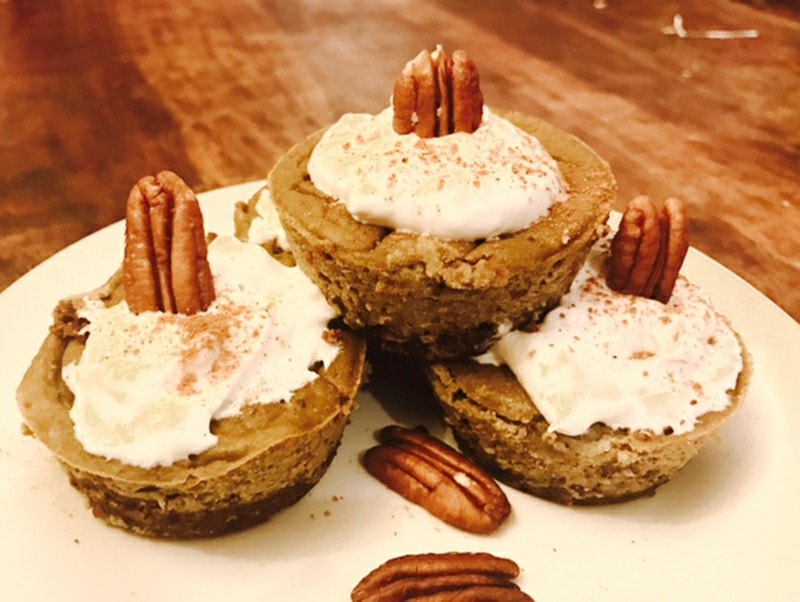
    On Thanksgiving, we had a vegan guest and Michelle wanted to make something special for her, so she made this amazing dessert—mini pumpkin cheesecakes— which ended up being my favorite!

    Enjoy!

    Ingredients

    Pumpkin Filling
    1 cup raw cashews, soaked in water 4-8 hours and drained

    1 cup canned pumpkin puree

    1 very ripe banana

    2 tbsp. lemon juice

    2 tsp. vanilla extract

    2 tsp. cinnamon

    1/4 tsp. nutmeg

    1/4 tsp. salt

    (Stevia to taste: Optional)

    Crust
    1/2 cup Gingersnap Granola (by Oh My Goodness Granola)

    1/2 cup raw pecans

    1/3 cup packed organic brown sugar

    1/4 cup Earths Balance vegan butter, melted (for non-vegan, feel free to use grass-fed butter like Kerrygold)

    Directions:
    Preheat oven to 300 degrees. For the crust, pulse the granola, pecans, and brown sugar in a food processor until it has a course sand texture. Add butter, and mix until well blended. Press into the bottom of muffin pan cups to form crust.

    Place cashews in food processor bowl. Blend until smooth, stopping to scrape down sides of bowl as needed. Add pumpkin, banana, lemon juice, vanilla, cinnamon, nutmeg and salt to food processor bowl. Blend again until smooth, stopping to scrape down sides of bowl as needed.

    Divide batter among muffin cups, placing a scant 1/4 cup full in each.

    Bake 20 minutes. Cheesecakes will still be a bit soft when finished baking. Transfer to cooling rack. Allow to cool completely and then refrigerate several hours, until fully set.

    Serve with coconut whipped cream and a sprinkle of cinnamon.

  • Autism, Politics, Vaccinations and Cytochrome P450

    Autism, Politics, Vaccinations and Cytochrome P450

    Spoiler alert: I’m going to talk about vaccinations.

    This subject has become so polarizing that any slight deviation from the establishment line on this—no matter how nuanced or reasonable—gets you lumped in with the antivaxxers, widely derided as crazies, science-denying, conspiracy-theorizing wing nuts.

    Believe me, I get the risks associated with speaking out about this. I know you can’t talk about the vaccination issue without pissing off large swatches of the population, not to mention risking the wrath and condemnation of your fellow health-professionals.

    I also get that the majority of the people reading this have already made up their minds on the subject of vaccines. Either you think it’s madness not to vaccinate, or you think it’s madness to vaccinate.

    Well, relax. I’m actually not writing this column for either group.

    I’m writing it for the small sliver of people who might still be somewhere in the middle.

    But first, let me introduce…

    Before we get into vaccinations and autism—and I promise, we will— let me introduce someone named Dr. Roger Williams.

    Roger Williams, MD, was the spiritual father of the whole integrative and functional medicine movement. Everyone in the “health space”—or at least, everyone you’re likely to be reading if you’re reading me— has studied Roger Williams’s landmark book—Biochemical Individuality. That book taught us that everyone is biochemically unique and that despite all our similarities, we should never lose sight of the enormous, measurable differences in all sorts of “out of the box” specifications. (I’ll get to why that matters in a moment.)

    Now let’s jump forward to the subject of vaccinations, specifically vaccinations and detoxification.

    Vaccinations and Detoxification

    Every single time you introduce any foreign substance into the body, that substance will ultimately wind up in the liver. The liver then begins the process of detoxification—essentially rendering the foreign object harmless, and turning toxins into water-soluble waste that can be eliminated through urine, stool, skin and sweat.

    The liver accomplishes this through a two-phase process of detoxification involving a group of enzymes called the Cytochrome P450 enzymes, and metabolic processes such as conjugation and glucuronidation. The end result—when all goes well—is that foreign compounds are effectively disposed of. These foreign compounds include (but aren’t limited to) toxins in the air, recreational drugs, pesticides, birth control pills, alcohol, prescription medicines… and, yes, vaccines.

    While Dr. Williams didn’t specifically study the Cytochrome P450 enzyme system, let’s look at what he did study and see if it might be able to shed some light on detoxification and vaccinations. I think it can.

    Dr. Roger Williams and Biochemical Individuality

    Williams showed illustrations of 19 different laboratory specimen human stomachs and 17 different human livers, each of dramatically different shape and size. He showed that the thyroid gland in normal people varies from a weight of 8 grams to 50 grams. He demonstrated that pepsin, an important digestive enzyme produced by the stomach, varies in the normal stomach by a thousand-fold.

    He reported dramatic differences among normal healthy infants in leukocytes, neutrophils, eosinophils, basophils, lymphocytes and monocytes, all specific types of blood cells.

    He reported on huge differences in the musculature of the pectoralis minor muscle, and on variations in the amount of islet tissue in the pancreas. He suggested that the potential rate of production for insulin probably varies throughout a ten-fold or greater range, and that the number of insulin-producing cells in the pancreas varies from 200,000 to 2.5 million—all, mind you, in normal people.

    So now I’d like to pose a theoretical question.

    Is it not possible that there might also be significant differences in the Cytophrome P450 enzyme system? The very same system that detoxifies foreign substances like, for example, vaccines?

    Is it completely impossible that different individuals might vary in the strength and effectiveness of their ability to detox effectively, perhaps due to inborn variations in their detoxification pathways?

    And could an unusual variation in the ability of one’s Cytochrome 450 enzyme system to function effectively under certain conditions of challenge—like a vaccine–explain why there might be an atypical, extreme response to a foreign compound even though that foreign compound doesn’t seem to cause harm in others?

    It’s hard to see how there could not be such individual differences.

    After all, if the detoxification system of the Cytochrome P450 enzymes worked exactly the same way at exactly the same efficiency with exactly the same results in every single human on the planet, then it would be the only such system in the human body that did so. (Remember, every other system Williams studied showed enormous individual differences.)

    And if you’re still skeptical about how this notion of individual variation could possibly apply to detoxification pathways, consider two people of the same size, age and sex: one drinks a bottle of Jack Daniels and walks a straight line home while reciting the Constitution, the other gets wasted on one beer. That difference in response to alcohol is almost certainly due to individual differences in the amount of an enzyme known as alcohol dehydrogenase, which detoxifies ethanol in the human body.

    We’ve all seen with our own eyes huge individual differences in the ability to handle alcohol. Is it so inconceivable that there might be significant differences in the ability to handle a particular vaccination?

    Isn’t it at least possible that there are some children— not all mind you, not even a majority, maybe not even a double digit percentage, but some percentage of children nonetheless—whose enzyme system simply cannot handle the challenge of the vaccination as it is currently given?

    Averages don’t tell the whole story

    Now please understand me here. I am talking about a small sub-set of children. And that’s a critically important point.

    See, when researchers do huge, studies looking for a connection between vaccinations and autism in multi-thousand patient populations followed over many years, they consistently find no relationship. And they are not lying. When you look at the data with that kind of helicopter view —which is exactly the way public health officials look at data—the conclusion is irrefutable. Vaccines don’t “cause” autism.

    So this is what you need to understand about that research, and about epidemiological research in general.

    The data on thousands and thousands of people followed over many years often obscures small sub-group differences.

    So a study that examined the medical records of, say 50,000 children who were vaccinated over the course of a decade would indeed find no increase in the incidence of autism.

    I completely accept that research—you’d be crazy not to.

    But there’s a “but”…

    I’m suggesting that there might be a sub-group of children, obscured in the averages, for whom the connection between autism and vaccines is a little more complex.

    Here’s an easy way to understand how something that is true for a sub-group can get completely lost in statistics about the general population.

    Malibu billionaires, Kentucky coal miners

    The United States is ranked internationally as the 8th best place in the world to get old.

    But suppose you’re in the small sub-group of people who have 25 million dollars in assets, happen to live in Malibu, and have unlimited access to the beach, the sun, the best food in the world and the A-team at Cedars Sinai.

    If you’re in that group—and believe me, those folks exist— the US is probably the best place in the world to grow old.

    But if you happen to belong to the small sub-group of retired coal-miners with black lung disease who live in western Kentucky on government assistance—and believe me, those folks also exist— the US might possibly be the worst place in the world to grow old.

    The point is that the averages don’t capture the experience of specific sub-groups.

    Taken as a whole, averaging all the numbers, the US is indeed the eighth best place to grow old. True dat. But that average rating simply does not adequately describe the real-life experience of specific groups—like Malibu billionaires or Kentucky coal miners. Their distinct, exceptional characteristics get lost when their numbers are folded into the averages.

    Is Cytochrome 450 variation worth exploring? Yes.

    Back to the liver and detoxification.

    What, if in those thousands of children who were studied for a connection between vaccinations and autism, there was, buried in the data, a small sub-group—just for fun let’s call them Cytochrome P-450-challenged individuals— who just couldn’t “handle the load” of the conventional vaccine?

    Overall, looking at millions of people over a decade or more, no causal connection could be seen between vaccines and autism. Of course there wouldn’t be. Millions and millions and millions of people are vaccinated and most don’t become autistic.

    But that doesn’t mean that’s the whole story.

    Flu shots for all? Not.

    It’s not as if we don’t all accept that there are special cases when we don’t recommend vaccines. After all, we tell people not to get a flu shot if they’re: elderly, infirm, or have impaired immunity.

    It’s also not as if there’s never been any evidence of harm from vaccinations before.

    There’s published research showing a connection between keratitis, an inflammation of the cornea, and the chickenpox vaccine. The reaction is rare, but it happens. Research also shows that 60% of girls given the supposedly 100% safe HPV vaccine, develop a condition called postural tachycardia syndrome. In fact, there’ve been so many reports of adverse effects from the HPV vaccination—including a few deaths—that the European Medical Agency if carrying out a review of the vaccine’s safety.

    Correlation is not causation… but still.

    Look, let’s be very clear about something. Drawing conclusions about causality when you’re talking about vaccines is almost impossible. And it’s a fool’s errand.

    You’re talking about millions of people being vaccinated in all kinds of circumstances, with adverse effects being reported sporadically and inconsistently, and with dozens, ne, hundreds of other variables operating concurrently that could be responsible for any adverse effects. And you have hard data showing that the vast majority of people who are vaccinated aren’t harmed. Drawing any cause and effect conclusions about something as complex as autism would be a statistical nightmare.

    I get that.

    And I believe that on balance, looked at purely in terms of number of people harmed vs. number of people helped, the public health value of mass vaccination outweighs the cost. More lives are saved than people are harmed.

    But that is small comfort to any parent whose child happened to be part of the collateral damage incurred for the greater good.

    Is there a “third way”?

    Much like American politics, the vaccination issue has created two polarized camps.

    On the one hand there’s the “antivaxxers”, many of whom call for a ban on vaccinations and all of whom are dismissed by the establishment as anti-science nut jobs.

    Yet many of these people are reasonable, thoughtful individuals who have observed real phenomena in their own homes with their own children, evidence dismissed by the establishment as “anecdotal”. Which it may in fact be, though that hardly makes it irrelevant.

    On the other hand, there is the establishment—all the major health and medical organizations—who dismiss any suggestions that the vaccinations might not be completely safe and urge vaccination for all in the name of public health. They suggest we look no further than polio and smallpox for proof of the conventional wisdom on mass vaccinations.

    There doesn’t seem to be any middle ground at all.

    But maybe there’s a third position, a third way of approaching the issue.

    And maybe it begins with giving those who have reasonable questions about vaccines a hearing rather than marginalizing them.

    Maybe it begins with the consideration that there are significant individual differences in Cytochrome P450 enzyme systems and detoxification pathways, and that some people might indeed be more vulnerable to ill effects from a safe (for most people) vaccine.

    And if there is a group of people who are more vulnerable to ill effects from certain vaccines—just as the elderly and the infirm are more vulnerable to ill effects from the flu shot–wouldn’t it be good to pursue ways to test to see who might be at risk?

    That might be a far wiser approach than marginalizing and demonizing anyone who questions vaccination orthodoxy— even when, as I hope this article did, questioning that orthodoxy is reasonable, nuanced, and very much in the spirit of finding answers.

  • The Sugar Deception: How Long Has This Been Going On?

    The Sugar Deception: How Long Has This Been Going On?

    The saddest thing about this week’s “shocking” revelations regarding the sugar industry is not what the sugar industry actually did but; what’s really sad is that this is the first time most people are learning about it.

    If you happened to miss the headlines of the past week, here’s what happened.

    Recently discovered documents show that the sugar industry, in a campaign that started almost a half century ago, paid a lot of money to make sure that the blame for cardiovascular disease, diabetes and obesity was placed squarely at the feet of saturated fat.

    That campaign is still going on today. (Read on.)

    Go back in time with me for a moment. It was the mid-1960’s and an increasing amount of research was pointing in the direction of sugar as the real culprit in heart disease. The sugar industry was not happy. It fought back by funding research of its own, the sole purpose of which was to cast scientific doubt on what the anti-sugar research was saying. In one case, the National Confectioners Association even managed to rope a nutrition professor at Louisiana State University into doing a study purporting to show that sugar was actually good for weight loss, leading to the CBS news headline, “Does candy keep kids from getting fat?”.

    Specifically, according to a paper published this week in JAMA International Medicine the last forty years of horrible dietary advice condemning fat was basically a dog and pony show funded by the sugar industry. It was not, and never was– as my colleagues and I have been saying for decades— based on science.

    The JAMA paper shows that in 1965, John Hickson—an executive in the sugar industry—hired two Harvard researchers to write a research review, the purpose of which was to debunk all the anti-sugar research that was coming out at an alarming rate.

    Oh, and the research they wanted the Harvard dudes to review was thoughtfully provided by the sugar industry.
    Obviously I wasn’t there, but I can tell you exactly how that conversation went.

    Sugar executives:

    “Listen boys, we’re feeling like perhaps sugar isn’t getting a totally fair hearing here. We think there are some mighty good things about sugar, I mean; pleasure is an important part of life, right? And it’s so easy to just exercise off those extra calories.

    Now we don’t want to influence you fellas in any way—after all, your scientific integrity is of top concern to us—but we’d like you boys to do an objective review of the studies and just give us your honest opinion. Of course we won’t interfere with what you write, we would never do that, we have far too much respect for you boys as scientists!

    And if you don’t mind, we’d love to see it as you’re working on it. We might have some valuable info we can contribute. Of course, we won’t change anything—we might make a suggestion or two, but other than that, we’re completely hands off!

    You boys understand what I’m saying here, don’t you?”

    The researchers understood perfectly. They always do.

    The sugar industry paid them about 50K in today’s dollars.

    And…ladies and gentlemen… this goes on, let’s see now…. ALL THE TIME!

    It’s worth mentioning that numerous studies show that industry funded studies are four to five times more likely to get the desired “positive” results than studies not sponsored by industry. And that’s true whether the industry is Big Pharma, Big Food, or Big Sugar. Or even, it pains me to admit, the natural products industry. The only difference is that we’re selling products that will almost never harm you. They’re selling products that will almost always kill you.

    Some of you may be familiar with my book, The Great Cholesterol Myth in which Dr. Stephen Sinatra and I detail exactly how the dietary guidelines came to be written and how they came to demonize fat. Here’s the summary: In 1977, the US Senate Select Committee on Human Nutrition—also known as the McGovern Committee—had come to the end of its tenure, and was about to disband. But they wanted to go out with a legacy document– some guidelines for the country on how to eat healthy.

    The cockamamie theories of Ansel Keyes (the genius who came up with the idea that saturated fat and cholesterol cause heart disease) were being pushed on the committee by Keyes and his minions, but there was far from universal acceptance that fat was in fact the bad guy.

    John Yudkin—the Dr. Oz of England, and a distinguished professor of nutrition on the other side of the pond—was adamant that sugar was the main cause of heart disease. Other reputable scientists thought the “fat causes heart disease” to be completely batty. (Framingham researcher and biochemist George Mann of Vanderbilt University famously said that the notion that cholesterol and fat caused heart disease was “the biggest scam ever perpetrated on the American public”. Since the McGovern Committee was made up of mostly young Washington lawyers with zero nutrition background, they needed some scientific cover before endorsing any dietary recommendations.

    So they turned to Harvard professor Mark Hegsted.

    Who, as it turns out, was one of several Harvard professors who were very much in the pay of the sugar industry.

    “Oh that Keys fellow is completely right”, said Hegsted, essentially. “It’s fat that causes all the problems”. (You can almost hear Jon Lovitz as Pathological Liar on SNL going, “Yeah! That’s the ticket!. It’s fat! Yeah! That’s the ticket!)

    So under the guidance of Hegsted, we get the dietary guidelines, the low-fat diet, the food pyramid, and an epidemic of diabetes, obesity, and heart disease.

    And now, shocker of all shockers, we find out that the sugar industry manipulated public opinion, funded friendly research, attacked opposing views, and used their massive lobbying budget to influence the dietary recommendations that have been making us sick, fat, tired and depressed for about forty years now.

    Stanton Glatz, professor of medicine at UCSF, and an author on the JAMA paper, talked to the New York Times about the actions of the sugar industry. “By today’s standards”, he said, “They behaved very badly”.

    Oh really? By today’s standards? No, my dear Dr. Glatz, by today’s standards they were positively tame. Industry influence on what we think is pure “science” is not a relic of times gone by, it’s here with us every single day, and it’s getting worse, not better, Have we forgotten already that as recently as 2015—last year, for goodness sake—Coca Cola was funding the seemingly “objective” research organization called The Global Energy Balance Network, the sole purpose of which was to fund research to show two things: people are fat because they don’t exercise, and a calorie is a calorie.

    Which, of course, would mean that calories from sugar aren’t any worse than calories from any other source, and as long as you exercise you’ll be just fine.

    Which, of course, is utter bullshit.

    Does this mean we should never trust “science”? No. But it does mean that we should all be painfully and acutely aware of the fact that almost all science these days is funded by those who have something to gain from the results.

    It’s not objective, pure, knowledge-for-the-sake-of-knowledge research that has no other purpose than to discover “the truth”.

    Instead, science is all-too-frequently nothing more than cover-your-ass justification for the selling of a product.

    I don’t know where I first heard this saying but it’s one of the truest things I’ve ever heard:

    When science meets marketing, the first casualty is truth.

    These days, science doesn’t just “meet” marketing.

    It’s married to it.

  • Grass-fed meat: Hype or Hope?

    Grass-fed meat: Hype or Hope?

    This is a fact: Cows weren’t meant to eat grain. Seriously.

    It’s just not their natural diet. You can make them eat it, just like you can make lions in the zoo eat Cheerios, but it’s not what they normally eat, and they won’t do well on it.

    And you won’t do well if you eat the meat of grain-fed cows. Here’s why.

    Cattle in the U.S. begin life on a pasture, and usually stay there for 12-18 months. But then about 97% of them get shipped off to feedlots—also known as CAFOs, or confined animal feedlot operations— and that’s where the problems really begin.

    From the point of view of Big Food, feedlot operations are awesome. Grains are superb at fattening cattle. (You might have noticed that they do the same thing for most humans.) So are antibiotics—which feedlot farmed animals are given a ton of; antibiotics fatten the cows right up. And even if they didn’t, those antibiotics are still needed because the cattle get sick from the double whammy of being confined in such close quarters and being forced to eat an unnatural diet of grains. They’re also given hormones (like bovine growth hormone). All this stuff winds up in their meat, and—especially— in their fat.

    So the meat (and milk) that comes from cows that primarily spend their life being fattened up on grain at CAFOs is simply not the same meat or milk that comes from their pasture-fed, grass-grazing brethren. The fat content is different, the nutrients are different, and except for the fact that they both contain the same amount of protein, grain-fed meat is just not the same food as grass-fed meat.

    Organic meat and grass-fed are not the same thing, though a lot of grass-fed meat is also organically raised. Organic meat that’s not grass-fed may indeed be free of some unwanted chemicals, but it is still nutritionally inferior to grass-fed meat, because when a ruminant is taken off pasture and fattened on grain, it loses a number of valuable nutrients.

    Compared with grass-fed meat, grain-fed meat has only one-quarter as much vitamin E, one-eighth as much beta-carotene, and one-third as many omega-3 fatty acids, if indeed it has any omega-3 at all. Feeding large amounts of any type of grain to a grazing animal will have this effect simply because grain itself has fewer of these nutrients than fresh pasture does. And since most of these animals are corn-fed, and since over 90% of corn in the US is genetically modified to contain the Bt toxin, one can only speculate what effect this has on the quality of the meat that comes from these animals, and on the health of the people who consume them. (Monsanto—that wonderful, public-minded company that gave us Agent Orange– assures us that GMO food like their Bt-toxin containing corn is completely harmless to humans. I don’t know about you, but that sure makes me feel a lot better.)

    Grain-fed animals also produce far more of the proinflammatory omega-6s and far less of the anti-inflammatory omega-3s. The balance between these two fats is essential to human health. We get far too many omega-6s and far too few omega-3s. The fat in grass-fed animals is much closer to a healthy balance between these two essential fats. The fat in grain-fed animals is heavily weighted in favor of the pro-inflammatory omega-6 and only contributes to the imbalance in our diet.

    Compared with grass-fed products, organic grain-fed products are also relatively deficient in a cancer-fighting fat called CLA—conjugated linolenic acid. CLA has been widely studied for its anti-cancer and tumor-fighting ability, as well as for its ability to reduce the accumulation of abdominal fat. CLA may be one of the most potent cancer-fighting substances in our diet. Feeding animals a diet with as little as 1% CLA significantly inhibited tumor growth and prevented the spread of breast cancer cells to lungs, peripheral blood, and bone marrow. When you feed a ruminant grain—even as little as two pounds a day—its production of CLA plummets..

    So as far as I’m concerned, grass-fed meat is the only way to go.

    While you can get grass-fed meat at farmers markets and through collectives, it’s not always easy to find. Fortunately, there’s a great online source that I’ve been enjoying for years and that I totally vouch for. It’s called US Wellness Meats. I know the owner, John, and I feel you can totally trust their products.

    US Wellness is the only place I know where you can get grass-fed pemmican, a natural kind of beef jerky-type snack that is kind of the original, ultimate “Power” bar. Based on a tried and true historic Native American recipe, it contains beef jerky, beef tallow, water, cherries, a drop of honey and sea salt. It’s amazing.

    You can try any of the terrific US Wellness Meats products by clicking here.

    I promise, if you try it, you’ll never go back to conventionally raised, toxic meat.

  • Heart-Protective Carrot-Ginger Soup with Chives

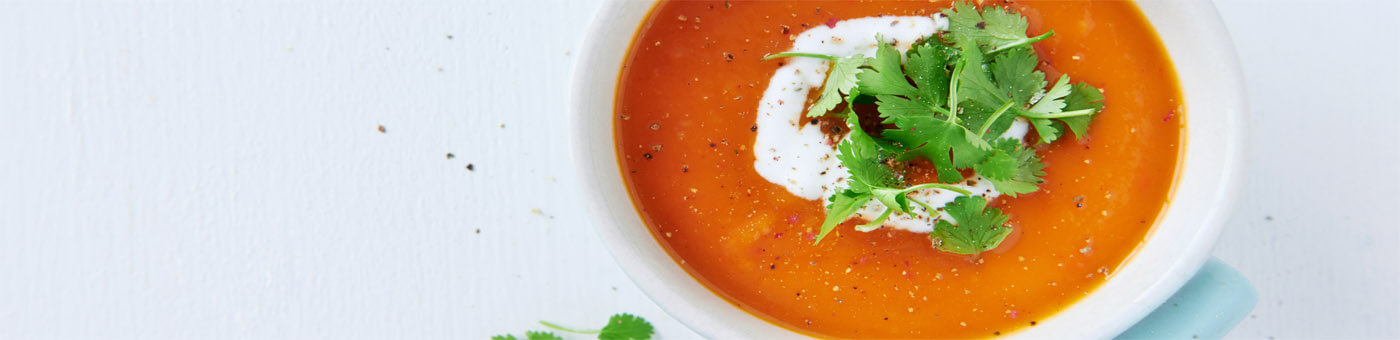
    Heart-Protective Carrot-Ginger Soup with Chives

    The following recipe is from The Great Cholesterol Myth Cookbook by Jonny Bowden, Stephen Sinatra, and Deidre Rawlings.


    Roasted vegetable tomato soupTangy, tasty, and warming from the inside out, the combination of carrots with ginger will delight not only your taste buds but your entire digestive system. This soup is packed with the antioxidants vitamin A and beta-carotene, together with tons of fiber and B-complex vitamins, it doesn’t get better than this for high-energy, nutrient dense soup.


    Ingredients:

    • 2 tablespoons extra-virgin olive oil or coconut oil
    • 1 large onion, chopped
    • 6 large carrots, chopped
    • 2 cups chopped butternut squash, skin on
    • 5 cups vegetable stock
    • 1/2 teaspoon salt, Celtic or sea
    • 1 teaspoon chopped fresh ginger, peeled
    • 1/4 teaspoon each ground cumin, coriander powder, and garlic powder
    • 1 cup chopped fresh parsley
    • 6 tablespoons plain yogurt
    • 2 tablespoons chopped fresh chives


    Instructions:

    Melt the oil in a large pot. Add the onions and cook for several minutes over medium heat until they begin to sweat. Add the carrots and butternut squash and cook for about 3 minutes. Add the vegetable stock, salt, ginger, cumin, and coriander and garlic powders. Bring to a boil, reduce the heat, and simmer, about 15 to 20 minutes, or until you can pierce the pieces easily with a fork.

    Purée the soup in a blender or food processor with the parsley. Serve with 1 tablespoon of yogurt in each bowl and top with fresh chives.

    Yield: 6 servings

    Note: Ginger is a stimulating herb that gets the blood flowing and the circulation going. Because of this, it can make you feel warm when nothing else seems to do the trick.

  • Healthier Holiday Nog

    Ingredients

    • 4 fresh, clean, organic, pasture-raised eggs, separated*
    • ¼ cup light palm sugar (or regular sugar)
    • 1 cup organic heavy cream, preferably from pastured cows
    • 2 cups organic whole milk, preferably from pastured cows
    • 1 teaspoon vanilla extract
    • ¾ teaspoon fresh-grated nutmeg, plus extra to garnish


    Place the egg yolks and 2 tablespoons of the sugar into a mixing bowl and beat until it thickens.

    Place the egg whites and remaining 2 tablespoons of sweetener into another mixing bowl and beat until soft peaks are formed.

    In a third bowl, add the cream and beat until it starts to thicken. Add the milk, vanilla and ¾ teaspoon nutmeg and beat until well incorporated.* Add the yolks and beat in. Finally, fold in the whites until well incorporated. Divide into cups and sprinkle each one liberally with extra nutmeg to serve.

    Yield 6- 8 servings

    *To make it a cocktail, add 2-3 ounces of white rum or bourbon when you add the milk.

    NOTE:

    *As a chef I am duty-bound to mention the FDA caution in consuming raw or partially cooked eggs because of the marginal risk of contracting salmonella or another food-borne illness. On the one hand this is a real concern because, unlike other food-borne illnesses, the number of salmonella cases has actually increased over the past 15 years. However, the contamination of eggs usually originates in contaminated factories with unhealthy chickens.

    Does this mean you should never eat raw eggs? If you buy conventional eggs from industrial farms, the answer to that question is probably yes. However, to avoid contaminated eggs, what you really need to avoid is contaminated feed and factory farming conditions. The solution is to purchase your eggs from smaller, free range, organic poultry farms, preferably local, where you can see happy, healthy chickens scratching in a field. Know where your food comes from. I personally eat raw eggs. I love them in smoothies, in Caesar dressing, and in egg nog, but only if they are from healthy, pasture-raised chickens on smaller, clean, local farms.

    To further reduce your risk of any contamination, wash any eggs that aren’t perfectly clean, always keep them refrigerated, and try to keep the egg contents from coming in contact with the outside of the shell when you crack them.

  • Rack of Lean Lamb with Herbs and Roasted Shallots

    The following is from The 150 Healthiest Comfort Foods on Earth by Dr. Jonny Bowden and Jeannette Bessinger for Fair Winds Press.


    For the moment, let’s put aside any concerns we might have about eating lamb (and yes, I’m a sucker for these gorgeous gentle creatures and have a few ‘tree-hugging’ sympathies of my own). But the fact is lamb is one of the healthiest meats on the planet. Precisely because it’s young (under a year old by definition) the animal hasn’t had too much time to accumulate toxins. In general, lamb isn’t “factory farmed”, so added antibiotics, steroids and hormones aren’t the problem they are with factory farmed beef. (And if you really want the best, it’s possible to get grass-fed New Zealand lamb at many grocery stores or butchers.) Lamb is high in protein, relatively low in fat, and contains zinc, niacin, selenium, vitamin B3 and all 8 essential amino acids. The Frenching process removes the layer of heavy fat leaving the exposed lean and tasty chops. To bump up the flavors even more, we marinate—overnight, if you can- with a fabulous mix of mint, rosemary and thyme, all of which really pop the flavor of the already tender meat. Serve it with creamy roasted shallots on the side- it’s comfort food at it’s best! Fun fact: marinating with herbs like rosemary before cooking or grilling significantly reduces heterocyclic amines, a potential carcinogen (cancer-causing compound), according to research by J. Scott Smith, PhD, at Kansas State University.

    • 2 racks of lamb, trimmed and Frenched (about 8 ribs or 1 pound each)
    • ¼ cup olive oil, divided
    • 4 cloves garlic, minced
    • 2 tablespoons minced fresh mint
    • 2 tablespoons minced fresh rosemary
    • 1 tablespoon minced fresh thyme
    • ½ teaspoon coarse ground pepper
    • 8 shallots, peeled
    • ½ teaspoon salt, or to taste

    Slice each rack in half so you have 4 sections of about 4 ribs each.

    In a small bowl, mix together 2 tablespoons of the olive oil, garlic, mint, rosemary and thyme. Smear the mixture evenly all over the surface of the meat and sprinkle evenly with the pepper.

    Wrap them with plastic and marinate in the refrigerator overnight.

    The next evening, preheat the oven to 400 degrees F.

    Coat the shallots in a thin coating of olive oil and set aside.

    Remove the racks from the refrigerator and peel away the plastic wrap, removing any large pieces of herb.

    Sprinkle lightly with salt and heat the remaining 2 tablespoons of oil in a large ovenproof skillet over medium high heat.

    Sear the fatty sides until golden brown, about 4 minutes.

    Flip the racks so they are sitting fat sides up. Arrange the prepared shallots around the lamb racks and place the pan in the oven. Cook for 20-25 minutes or until desired doneness –watch the shallots closely: Turn them once and remove if they are getting too browned. Let the racks rest for 10-15 minutes before cutting. To serve, slice the racks into chops and serve with a couple of the roasted shallots on the side.


    Yield: 4 servings


  • Three Great Holiday Recipes

    Three Great Holiday Recipes

    [et_pb_section fb_built=”1″ _builder_version=”3.22″ _i=”0″ _address=”0″][et_pb_row _builder_version=”3.25″ background_size=”initial” background_position=”top_left” background_repeat=”repeat” _i=”0″ _address=”0.0″][et_pb_column type=”4_4″ _builder_version=”3.25″ custom_padding=”|||” _i=”0″ _address=”0.0.0″ custom_padding__hover=”|||”][et_pb_text _builder_version=”3.0.74″ background_size=”initial” background_position=”top_left” background_repeat=”repeat” _i=”0″ _address=”0.0.0.0″]

    The following three recipes are from Jeanette Bessinger, the Clean Food Coach, www.thecleanfoodcoach.com.

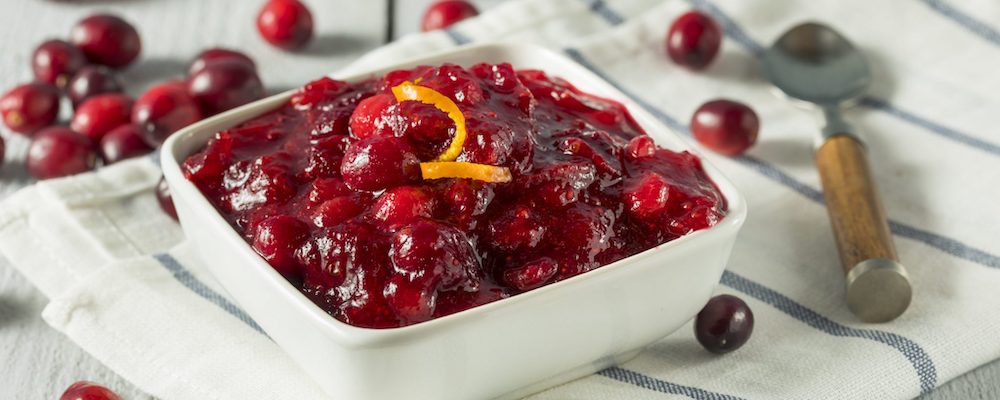
    Autumnal Antioxidants: Cranberry-Orange Relish

    This tangy orange-cranberry relish is made with fresh cranberries, not canned, and less than half the sugar of conventional canned relish. You may not realize it, but cranberries are one of the healthiest foods on earth. They have one of the highest antioxidant ratings, and are loaded with plant compounds known as flavonoids, which may reduce the risk of atherosclerosis. Emerging research also indicates that they may help protect brain cells. In any case, they taste great, and this fabulous relish is a perfect complement to the heady, herb-infused turkey!

    • 4 cups (440g) fresh cranberries, or 2 8-oz (225-g) bags frozen/unsweetened, thawed and rinsed
    • 2 oranges, peeled and halved
    • ½ cup (230 g) raw honey, or more or less to taste (or palm sugar)

    In a blender or food processor, blend together the cranberries, oranges and honey until a juicy relish is formed.

    Yield: 12 to 14 servings

    Notes from Chef Jeannette:

    Cranberries are not only delicious and nutritious, but also beautiful. If you wish to serve a canapé or cheese platter during a holiday gathering, fill your serving platter with a bag of fresh cranberries and place the food items on the top –lovely!


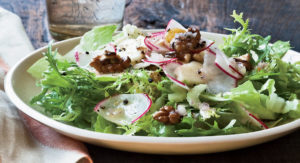
    Holiday Waldorf Salad

    Adapted from The Healthiest Meals on Earth: The Surprising Unbiased Truth about What Meals to Eat and Why by Dr. Jonny Bowden and Jeannette Bessinger for Fair Winds Press.

    Ingredients

    • 1/3 cup plain Greek yogurt
    • 3 tablespoons fresh squeezed orange juice
    • Juice from 3 tablespoons grated ginger root
    • 1 tablespoon raw honey or coconut nectar, or to taste
    • ¼ teaspoon powdered ginger, optional
    • 2 small crisp red apples (such as Macoun or Pink Lady), cored and chopped into small pieces (about 2 cups)
    • 4 celery stalks, thinly sliced
    • ½ cup purple seedless grapes, cut in half, optional
    • ¼ cup dried cranberries, cherries or chopped figs or dates
    • 1/2 cup lightly toasted walnuts or caramelized almond slices, coarsely chopped
    • 8 cups chopped hearts of Romaine

    In a small bowl, whisk together the yogurt, honey, orange juice and gingers. Set aside.

    In a salad bowl, combine all remaining ingredients through Romaine.

    Pour dressing over the salad and toss together to coat.

    Yield: 6-8 Servings

    Notes from Chef Jeannette:

    Replacing conventional mayonnaise with high protein, pastured, organic Greek yogurt transforms this timeless dish into a healthy classic.


    Easy Spiced Pumpkin Pie

    By Jeannette Bessinger, the Clean Food Coach, www.thecleanfoodcoach.com

    After years of baking pumpkin pies I’ve simplified a formula for a delicious, no-bake version that is grain-free, dairy-free, speedy and easy to make, even for non-bakers like me! This is sort of an interactive recipe because you need to decide what your priorities are –i.e. are you looking for the highest protein and lowest glycemic load? Try the tofu and Orange NuStevia combination. Don’t eat soy? Go with the avocado for the binder (it will not set as firmly as the soy). Looking for something a little sweeter and more traditionally flavored? Use canned pumpkin and pure maple syrup. You can even put the filling into a traditional baked flour crust – it’s still going to be a much healthier pie than any conventional option. Experiment a bit to hit the sweet level you enjoy and make it your own, tailored to your personal tastes and dietary goals.

    Crust Option #1

    • 2 cups macadamia nuts (raw or roasted)
    • 2 tablespoons finely grated fresh ginger
    • Pinch salt


    Crust Option #2

    • 2 scant cups walnuts
    • 1/3 cup fresh pitted Medjool dates (soak for 15 minutes if they are not soft and fresh)
    • 1½ teaspoons pumpkin pie spice
    • Pinch salt

    Filling

    • 2 cups fresh-cooked pumpkin * (or sweet winter squash, such as kabocha), drained if runny
    • 1/3 cup pure maple syrup or ½ cup rice syrup
    • 1 12.3-ounce package firm silken tofu or 2/3 cup lightly mashed ripe hass avocado
    • 1 teaspoon vanilla extract
    • 1½ teaspoons cinnamon
    • 1½ teaspoons ginger
    • ¼ teaspoon cloves
    • ¼ teaspoon allspice
    • Pinch salt

    Instructions

    To make the crust, combine all the crust ingredients from either option 1 or option 2 in a food processor. Slowly pulse and process, turning the mix over occasionally for even processing, until it looks like fine crumbs and holds together well when you pinch it between your fingers. If it’s under-processed it will not stick together, but if it’s over-processed, it will turn into an oily nut butter.

    When the consistency is right, transfer contents into a 9-inch pie plate and press evenly into the bottom and up the sides of the plate, scalloping around the edges with your thumbs, if desired. Place the crust in the freezer to help it set while you prepare the filling.

    To make the filling, combine the pumpkin, sweetener, spices and salt in a food processor and process until smooth and well-mixed. Add the tofu or avocado and process until completely incorporated (it takes a little longer for the tofu, and a little less time for the avocado). Spoon the filling into the crust and refrigerate for two hours to set completely. You can serve the pie at room temp, but it will be very soft.

    Yield: 8 servings

    Notes from the Clean Food Coach:

    *To cook a sugar pumpkin (or any large winter squash), simply cut it in half and remove stem and seeds. Cut each half into quarters (or eighths if the pumpkin is more than a few pounds) and cook on low in a slow cooker for 6-8 hours or until tender. Scoop out the flesh for use and discard the skins. Puree the cooked flesh in a food processor and drain in a double mesh sieve for at least 30 minutes if runny.

    You can also use high quality organic cooked pumpkin, but it will taste a bit blander than fresh-cooked –consider adding another half teaspoon of ground ginger or cinnamon to the filling.

    [/et_pb_text][/et_pb_column][/et_pb_row][/et_pb_section]
  • Free Range Citrus-Stuffed Herbed Turkey

    Free Range Citrus-Stuffed Herbed Turkey

    The following is from The 150 Healthiest Comfort Foods on Earth by Dr. Jonny Bowden and Jeannette Bessinger for Fair Winds Press.


    From Dr. Jonny: The holidays don’t have to be a time when you stop eating healthy; you can still enjoy many of the fabulous comforting offerings the season provides in abundance. Here’s a tremendous and traditional holiday meal for you that won’t feel you leaving one bit deprived. The turkey and cranberry-orange sauce are borrowed from The Healthiest Meals on Earth—one of our most popular recipes but the dressing is all new. It’s a remake of a comfort food staple which, although classic, is usually a high-glycemic, low-nutrient affair that can wreak havoc with your waistline. Our version is way better and just as tasty.


    Free Range Citrus-Stuffed Herbed Turkey

    We made the turkey “sans gravy” and stuffed it with a flavor-rich combo of herbs and citrus for a juicy and aromatic bird. (Free-range turkey only, please! You don’t need the added hormones and steroids!) Traditionally, this type of a whole-bird preparation calls for at least one stick of butter, but we reduced it and mixed it with olive oil, giving you a nice mix of heart-healthy fat and valuable olive phenols. (To get all the “good stuff,” use extra-virgin olive oil.) Fun fact: contrary to popular opinion, most of the fat in butter is actually monounsaturated fat, the same healthy fat found in olive oil!


    To Brine:

    • 1 18–20 lb turkey (free-range, not self-basting)

    You will need 2 to 3 gallons of brining solution for an 18–20 lb turkey.

    Per gallon of water, add:

    • 1 cup salt
    • ½ cup raw honey
    • 2 teaspoons finely grated lemon peel, optional
    • 2 teaspoons grated orange peel, optional
    • ½ tablespoon cardamom pods, optional
    • 1 teaspoon dried thyme, optional


    To Prepare the Turkey for Roasting:

    • 8 sprigs each of fresh rosemary (young and tender, not woody), sage and thyme, (1¼ to 1½ cups total when coarsely chopped)*
    • 2 shallots
    • 1 whole head garlic
    • 1 lemon
    • 1 orange
    • ½ stick butter, softened
    • 2 tablespoons olive oil
    • Salt and pepper, to taste
    • 1/2 cup sherry


    Starting with 2 gallons of water, mix the brining solution (salt through thyme) in the correct proportions, stirring until the salt and honey are dissolved. Rinse the turkey and pat it dry. Place the turkey in a lobster pot or large stockpot. Pour the brining solution to cover the turkey completely. Place turkey in the fridge for 12 to 24 hours. Remove, rinse very well under running water and dry thoroughly, including cavity. If you want crisper skin, brine and rinse the day before and place it, breast side up and uncovered in the basting pan in the fridge overnight to allow excess moisture to evaporate.

    Preheat oven to 400°F.

    Stem and coarsely chop the herbs, setting aside about ¾ (about 2/3 to 1 cup of herbs) of the total. Mince the remaining fourth (about ½ cup) of the herb mixture and put into a medium bowl.

    Peel the shallots and garlic. Cut shallots in half, crush garlic cloves, and add to herbs. Quarter but do not peel the lemon and orange and squeeze them gently to make a little juice, tossing fruit and juice together with other ingredients in the bowl.

    Using your hands, mix softened butter with olive oil in a small bowl until creamy.
    Moving carefully so as not to puncture the skin, work your hand between the turkey skin and the breast as far as you can go to create a pocket over both breasts. Smear half of the butter/olive oil mixture over the breasts, covering as much meat as you can reach.
    Place half of the reserved, coarsely chopped herbs in each pocket (on top of each breast). Do this carefully, and when complete, gently reshape (from the outside) the herb “pouches” above each breast to look rounded and smooth. Salt and pepper the inside of both cavities and stuff with fruit and herbs mixture. Tuck the wings behind the back, tuck the skin folds over the cavities to close, and truss the legs. Smear the entire bird with remaining butter/olive oil mixture, salt and pepper. Slowly pour sherry inside of the breast pockets, working it around to the leg joints.

    Place V rack inside of roasting pan and cover with foil.** Poke about 15 holes into the foil. Bake on V rack, breast side down, for 45 minutes then reduce oven temp to
    325°F. Turn bird breast side up, baste (can supplement juices with a few tablespoons of sherry if you wish), cover with tinfoil and continue to cook for about 2½ to 3 hours more, depending on the size of your bird. Remove the tinfoil to brown the breast and continue to cook for another 30 to 40 minutes, or until the thickest part of the breast and innermost parts of thighs and wings register at least 165°F on meat thermometer. When turkey is done, legs should roll loosely on the joint and the leg juices should run clear. Let rest on cutting board for about 20 minutes before carving.


    Yield: On birds more than 12 pounds, allow ½ to 3/4 lb per person, so an 18-pound turkey can serve between 24 and 36 people.


    Notes from Chef Jeannette:

    *If you are working with a large bird (that will take a longer cooking time) or desire a milder herb flavoring, use the whole stems (without chopping) under the skin. Just remove the large pieces when the cooking is complete and use as a garnish.

    **If you don’t own a V rack, try using 2 miniature loaf pans (4 or 5” by 3”), face down and set on either side of your roasting pan (in the middle, lengthwise). If using the loaf pans, no need for tinfoil.