If you work at Whole Foods, sooner or later someone is going to ask you about Smart Fat. And I, for one, think that’s a very good sign.
My book, Smart Fat: Eat More Fat, Lose More Weight, Get Healthy Now (co-authored with Steven Masley, MD) is about to drop (January, Harper Collins), and soon we’ll be seeing a virtual tsunami of books capitalizing on the term. Already, one famous nutritionist is re-publishing an older book that advocated for higher fat diets and has put “Smart Fat” prominently on the cover of the new edition. Another A-list nutritionist we know of is rushing to get his high-fat book out quickly, and there are sure to be more to follow. The concept of Smart Fat has arrived, and I want you to learn what Smart Fat means, right now, right from the horse’s mouth.
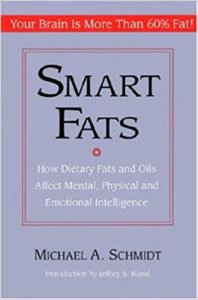 Full disclosure: Sometime after our book went to press, an old physician friend of mine sent me a link to a long out-of-print book called Smart Fats that had indeed been published years ago, but that neither Dr. Masley nor myself had ever heard of that book when we wrote—and titled—our new book. So for all intents and purposes, we invented the term Smart Fat for modern times, and I’m actually glad that so many distinguished writers and nutritionists are picking up on it because, as you’ll soon see, it’s a very useful term to have.
See, at one time in the not so distant past, we all believed that fat was bad and that low-fat diets were the key to health. Then, we slowly realized that not all fat was bad. Some fats—for example, fish oil and olive oil—seemed to be really healthy. So, we modified our old-fashioned demonization of fat in general, and came up with the notion of “good fat” (i.e., vegetable oils) and “bad fat” (i.e., trans fat and animal products).
Well, that was then. This is now.
You could, I suppose, think of the notion of “smart” fat as a much-needed update to the old, outdated notion of “good fat” and “bad fat.” The new way of looking at fat still recognizes that some fat is “good” and some is “bad,” but those categories are defined very differently.
It doesn’t matter whether a fat comes from an animal or a vegetable. The only thing that makes a fat “good” or “bad” is whether or not it’s toxic. Toxic fat is bad—regardless of its origins. Some of the worst fats are the ones we’ve been told are terrific for us, and some of the best fats may turn out to be precisely the ones we were wrongly told to stay away from.
Let me explain.
In any sentient being—humans, animals—toxins are stored in adipose tissue (i.e., the fat cells). Fat cells are storage central for any toxin that gets into the body and doesn’t get excreted. When you raise cows on a factory farms—also known as CAFOs (Concentrated Animal Feeding Operations)—here’s what happens. The cows are fed massive amounts of antibiotics to fatten them up and to keep them from getting sick due to their poor diet and crowded conditions. They’re fed steroids and hormones (like bovine growth hormone). They eat grain—an unnatural diet for ruminants—and it’s grain that’s been sprayed with every kind of pesticide and chemical you can imagine.
And guess what? All of that stuff winds up in the fat of the animals. And on your plate. And in your body.
The fat of those animals is a toxic waste dump. And it has absolutely nothing to do with whether it’s saturated or not—(about half the fat in beef is actually monounsaturated)—and it has nothing to do with whether or not it came from an animal.
I live in Southern California and we’ve had a couple of E. coli scares, traceable to contaminated spinach. But no one in their right mind thinks spinach is a “dangerous” food—everyone understands that a particular crop was contaminated by outside sources. The contaminated spinach was recalled, end of story, everyone can eat spinach and no one thinks it’s bad for you.
Yet the situation with toxic fat is exactly like the situation with spinach. Animal products aren’t bad for you because they’re animal products, any more than spinach is bad for you because it’s a vegetable. Animal products, just like vegetables, are only bad for you when the animals are contaminated. Which is exactly what they are when they’re raised on feedlot, factory farms—and this goes for chickens and pigs as well as for beef.
The fat from grass-fed animals, however, is a whole different story. Grass-fed animals—and pasteured pork, and free-range chickens—are raised on their natural diet. Cows are free to roam on pasture and chew on grass. They don’t eat an unnatural diet of grain. Chickens peck at bugs and worms and insects (good sources of omega-3). They’re not fed antibiotics. They aren’t fed hormones. Their fat is higher in omega-3 and lower in inflammatory omega-6. When I order grass-fed beef from Whole Foods or a farmer’s market, I never ask for the lean kind, because there’s no reason to. There’s nothing toxic in that fat at all.
Our book divides fat into three categories—Smart, Neutral and Toxic. Toxic fat is fat from animals that have been raised on feedlot farms. Toxic fat is man-made trans fat. Toxic fat is damaged fat—like canola oil that’s been used and re-heated many times at a fast food restaurant. And—although vegetable oil per se is not necessarily toxic, most of it is highly processed and refined, very high in inflammatory omega-6, and, in the quantities we consume it, not very good for us. (Contrary to the old definition, vegetable oil isn’t always good fat, and definitely isn’t “smart” fat!) Saturated fat, on the other hand, is completely neutral when it comes to promoting heart disease. And in some cases—like coconut oil or Malaysian palm oil—saturated fat actually has some benefits.
When we made the bone-headedly stupid mistake of banishing fat from our diets, we lost one of the best sources of energy on the planet, and replaced it with sugar which is at the heart of every major epidemic that has a nutritional component (diabetes, obesity, Alzheimer’s, heart disease, fatty liver disease). We removed sources of calories with significant health benefits (i.e. fish, olive oil, nuts, avocados, grass-fed beef, free-range chicken, eggs, whole-fat yogurt, coconut oil, Malaysian palm oil) all in the hopes of attaining some elusive health and weight benefits believed to accrue to a low-fat diet.
It hasn’t worked out very well.
My hope is that our book is a harbinger of a whole new way of thinking about fat. Fat is our friend. It helps balance our hormones. It keeps our brain healthy. It provides amazing energy. It keeps us full. It’s vital for absorbing critical vitamins (A, D, E and K) and other nutrients (carotenoids).
The old way of thinking—“good” fat= vegetable oil, “bad” fat= animal products—is woefully out of date. It’s about time we started looking at fat as something which- -when used the right way—has the potential to transform our health for the better.
Combined with the right amount of flavor, plenty of fiber, and liberal use of anti-inflammatory and antioxidant spices, the Smart Fat eating plan is one that has the power to change your life.
Posted on WholeFoods Magazine Online,
By Jonny Bowden, PhD, CNS aka “The Nutrition Myth Buster”™